Introduction
In 1954, Edward Montagu (the third Baron Montagu of Beaulieu), journalist Peter Wildeblood, and landowner Michael Pitt-Rivers were tried and convicted of "gross indecency" with men. It was one of the most notorious prosecutions for homosexuality in post-war Britain. The case became a media spectacle, contributed to the eventual Wolfenden Report (1957), and helped set the stage for the partial decriminalization of homosexuality in England and Wales in 1967.
The archival record of the case itself is remarkably incomplete. The trial transcript was once thought to rest at the National Archives in London, on the basis of a 2022 personal communication from the Wildeblood scholar Stephen Griffiths, who reported that "there is a copy in the National Archives" but had never put in a request to view it. Repeated inquiries since then have established that the National Archives does not in fact hold it: the document is not in their catalog, has not been surfaced in response to formal requests, and has not been located in any other public repository. Police records were never contacted. No single archive holds the relevant documentation. This fragmentation is not accidental. It is the product of archival systems that determine what is preserved, what is accessible, and ultimately, what version of history prevails.
Rather than reconstructing the trial, I use the Montagu case here as a lens through which to examine broader, internationally resonant questions about archival institutions. How do national archive infrastructures shape state record-keeping? How do access policies create or perpetuate silences? And what does the archival "multiverse" reveal about the gap between what institutions preserve and what they make available?
Key Concept: Archival Silence
Archival silence refers to the gaps in the historical record created not by the absence of events, but by the failure of institutions to create, preserve, or make accessible the documentation of those events. These silences are rarely neutral. They reflect power structures, social biases, and institutional priorities that determine whose stories survive.
The Archival Multiverse
Anne Gilliland's concept of the archival multiverse offers a critical framework for understanding the Montagu case's documentary landscape. Gilliland argues that archives do not exist as singular, neutral repositories. Rather, they operate within overlapping systems of power, culture, and institutional mandate that shape what is collected, how it is described, and who may access it (Gilliland, 2014).
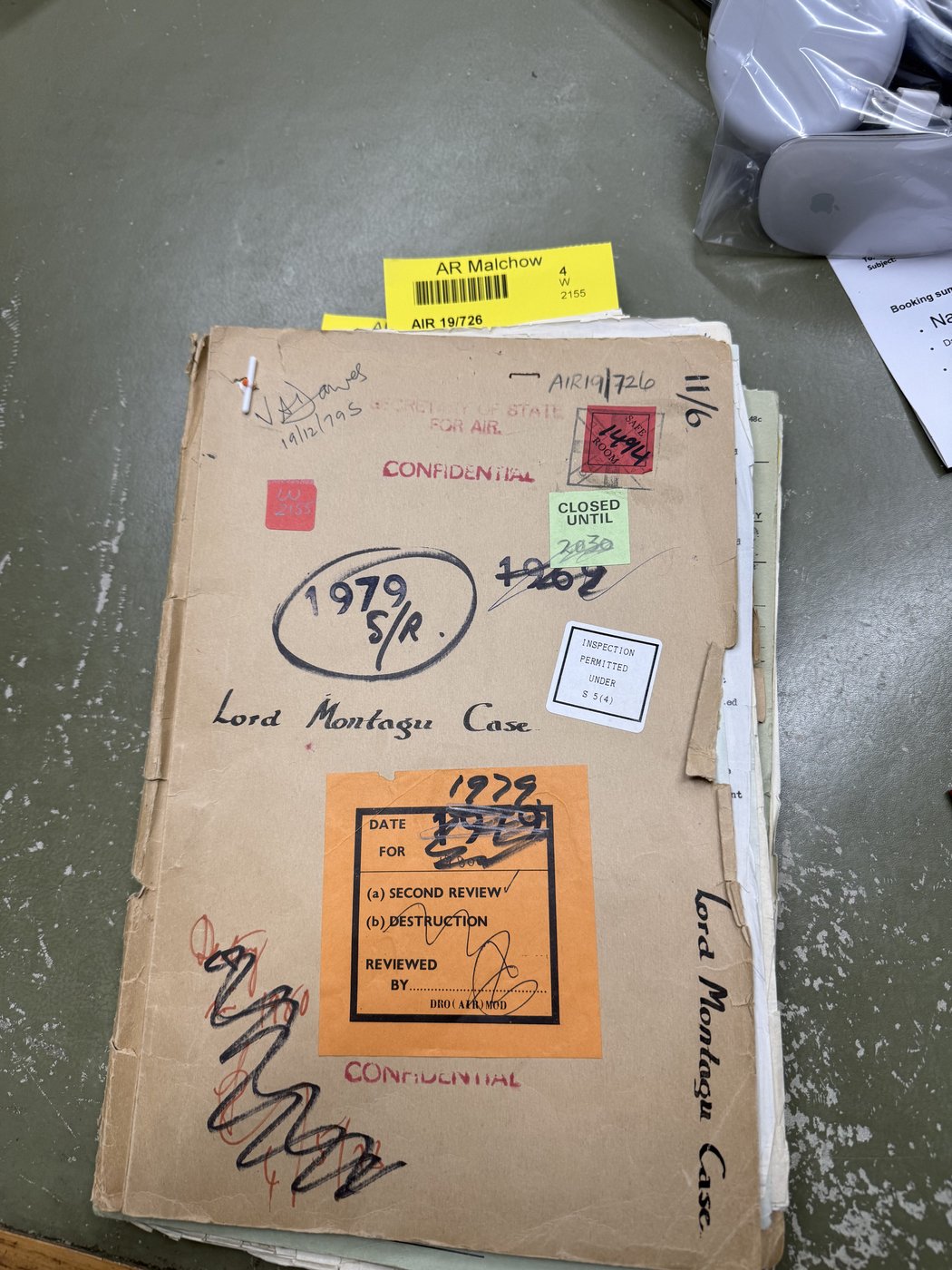
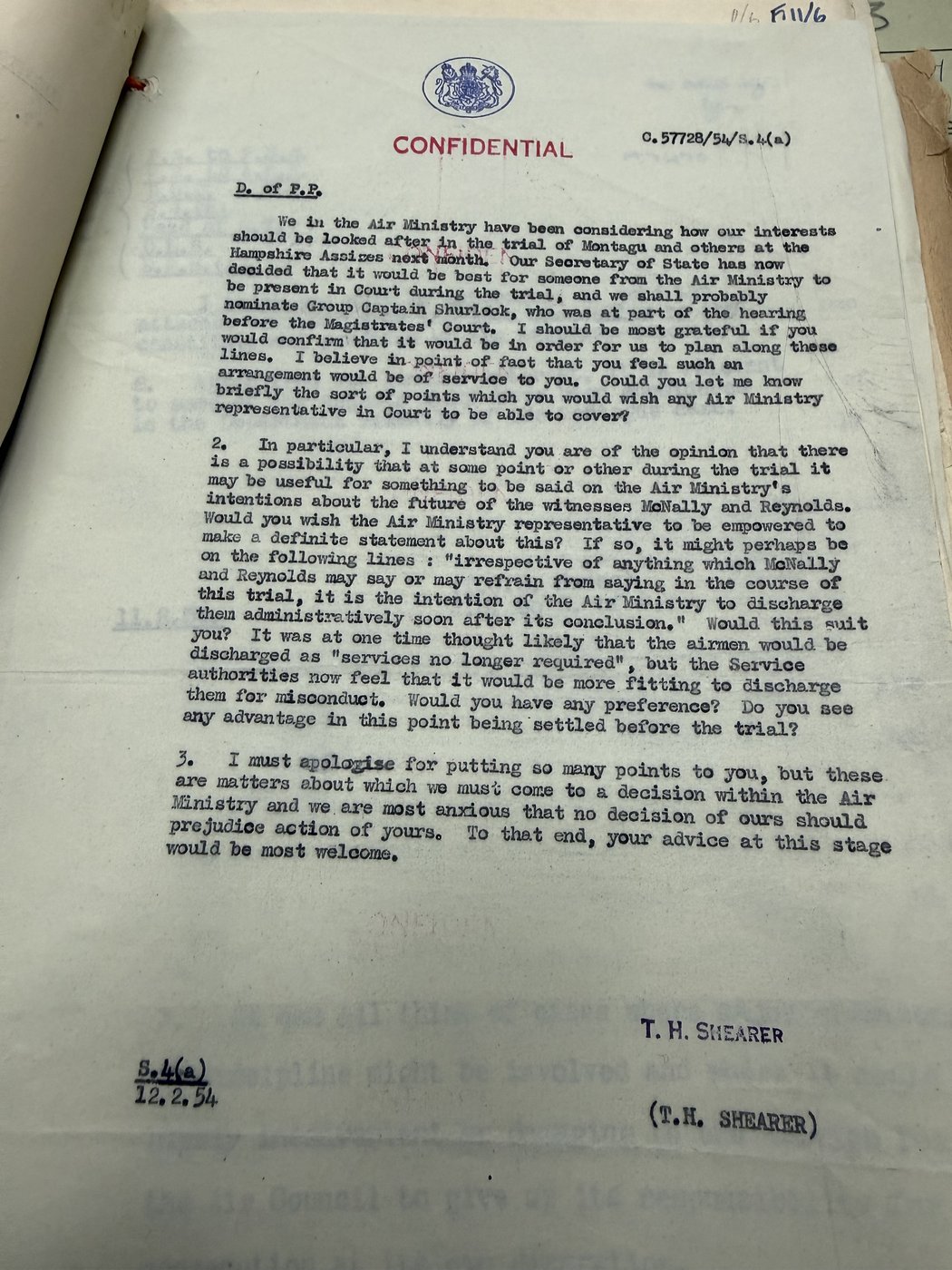
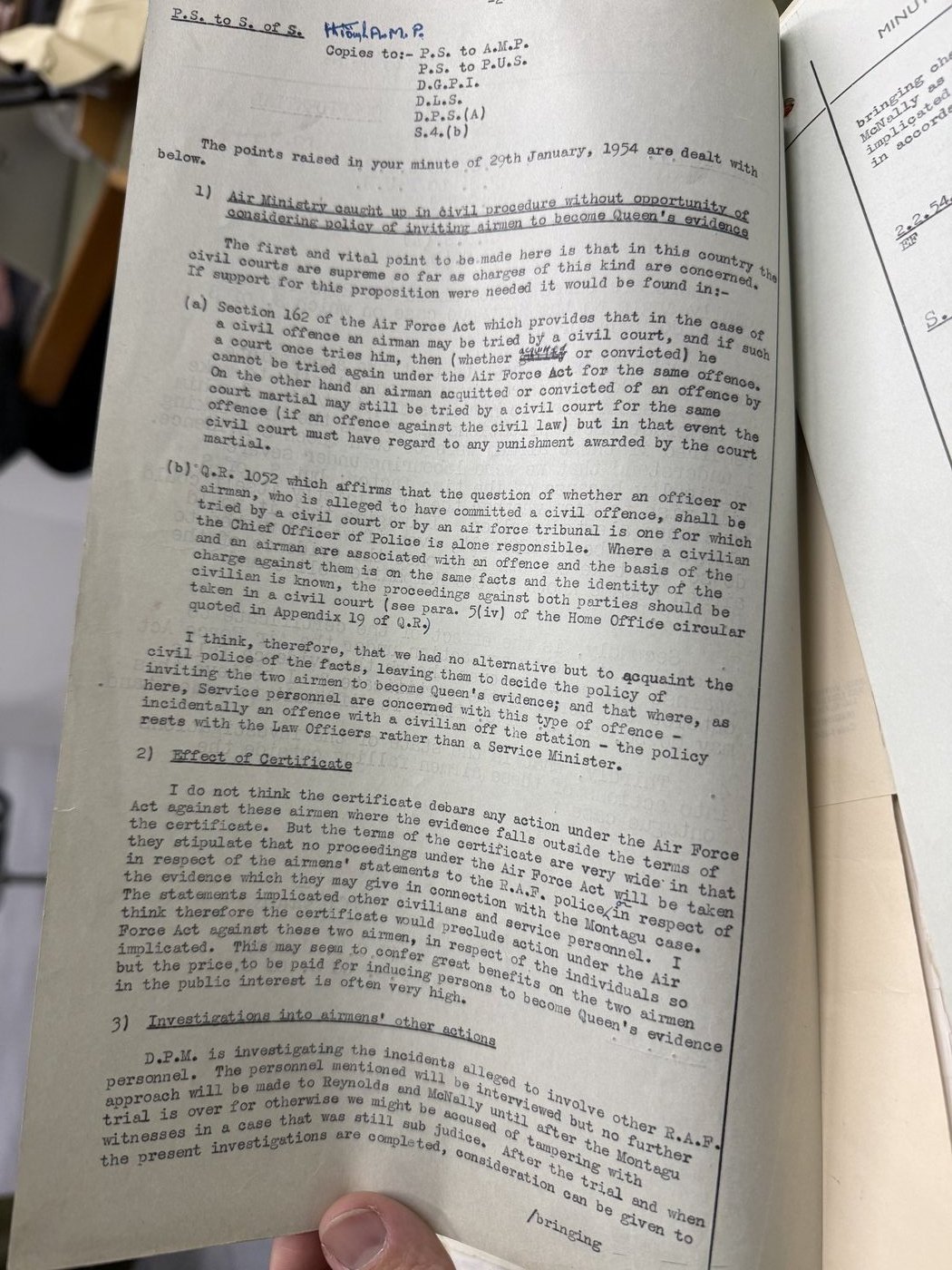
The records of the Montagu trial exist across precisely this kind of multiverse: a redacted Air Ministry file at the National Archives released through a Freedom of Information request, press clippings in newspaper archives, private correspondence in a bank vault, personal memoirs in published form, and police records that were never pursued. The trial transcript itself, assumed on the basis of Griffiths' 2022 personal communication to live at the National Archives, has not been found there or anywhere else. No single institution holds a complete picture. Each archive reflects its own institutional logic, and the gaps between them, including the absence of the transcript itself, constitute the silences in the historical record.
"The archival multiverse concept challenges the assumption that there is a single, neutral, and objective way of constructing, preserving, and accessing the documentary heritage of any society."
Anne Gilliland, "Conceptualizing 21st-Century Archives" (2014)
This fragmentation is not unique to the Montagu case. Internationally, records related to the prosecution and persecution of LGBTQ+ individuals are scattered across legal systems, police archives, medical institutions, and private collections. In many cases, the very institutions responsible for the persecution are also the custodians of the records documenting it, creating an inherent tension in access and interpretation.
The Montagu Case Across Documentary Environments
Court Transcripts
National Archives, UK
+
Press Coverage
Newspaper Archives
+
Private Papers
Bank Vault / Family
+
Police Records
Restricted Access
No single archive holds the complete documentary record. Each institution preserves a partial view, shaped by its own access policies and institutional mandate. Records marked in red remain difficult or impossible to access.
Access, Obstruction, and Archival Silence
The Cost of Access
The experience of attempting to access the Montagu trial transcript encapsulates the barriers that archival systems place between researchers and historical evidence. The search has run across several years and through every channel a researcher would think to try.
The earliest attempts, beginning in March 2022, ran through Harvard's law library and through Stephen Griffiths, the scholar who has written most directly on Wildeblood. Deanna Barmakian, the UK legal materials specialist at Harvard Law Library, checked Westlaw UK, the Lexis Library, ICLR, and HOLLIS, and reported that the case "was not officially reported," that the assizes courts no longer exist as a distinct system, and that "we don't have anything like that for this case" in any Harvard holding. Griffiths was equally direct in reply: "As far as I am aware [the] transcript of the Montagu trial has [n]ever been publicly released. There is a copy in the National Archives, but I have never put in a request to view it. There's probably a copy in the Montagu archives, but I don't believe that this is open to researchers." That assumption, that TNA holds a copy, traces specifically to Griffiths' 2022 reply to my earlier inquiry; he had not himself requested or seen the document. My own subsequent inquiries to TNA in 2024 and 2025 have not borne it out: the National Archives does not hold the trial transcript, and Griffiths' belief, though offered in good faith, was never verified at the source. Two qualified specialists, working independently, pointed at TNA and Beaulieu and admitted they had not confirmed either holding.
Picking up the same trail in late 2024, I went after both possibilities at once. On 18 December 2024 I filed an FOI request with The National Archives (Ref CAS-231773-Z8P5S7), submitted a research request to Hampshire Archives and Local Studies in Winchester, and used the Beaulieu Estate's contact form to ask whether the transcript was held in the family archive. The Hampshire reply on 24 December surfaced one document, "Lord Montagu and Kenneth Hume paper clippings" (200M86/A9/5/15/24), a packet of cuttings rather than a court record. The Beaulieu reply came in two parts. To the initial inquiry, the visitor office wrote: "We are very sorry but are unable to assist with this enquiry." When I asked, more specifically, where else I might look or whom on the estate to contact, Mehreen Shah replied on 31 December 2024: "We do apologise but are unable to assist you any further." The phrasing is the point. The estate did not say it does not hold the transcript. It declined to engage. The difference between absence and refusal is small in practical terms, the researcher ends up empty-handed either way, but it matters analytically. Refusal preserves the possibility that the document still sits somewhere in private hands; absence does not.
The TNA request unfolded across three more months. On 4 February 2025, the Freedom of Information Centre wrote that they could not meet the 30-day statutory window because "the complex nature of the requested information means that we have to consult with the transferring government department whose opinion must be sought before a decision can be made." On 4 March 2025, the answer came back: AIR 2/12513 would be released in redacted form, with two excisions made under Section 40(2). The file became available on 17 March 2025, and I subsequently traveled to Kew and reviewed it in person.
That visit produced AIR 2/12513, the RAF personnel file the next section analyzes in detail. It did not produce the trial transcript. To this point the transcript has not been found. The National Archives does not hold it, contrary to Griffiths' 2022 belief that a copy lay at TNA; the Hampshire record office holds only newspaper clippings; and the one private collection most likely to hold a copy will neither confirm nor deny. The most basic primary source one would expect to anchor a study of the case is, for the moment, simply out of reach.
These are not trivial barriers. They function as a filtering mechanism that determines who can afford to construct historical knowledge. As the Air Ministry and RAF files examined in the previous section demonstrate, even records that have been partially released arrive with redactions, closure notices, and missing pages. The FOI file's Section 40(2) exemption, a blank page inserted where a document once stood, is a visible monument to the limits of access. The result is that the dominant scholarly understanding of one of the most consequential trials in British LGBTQ+ history has been built primarily on newspaper coverage and personal memoirs, sources that, while valuable, are partial, biased, and in some cases demonstrably inaccurate.
FOI and National Archives: An International Problem
Freedom of Information frameworks vary dramatically by country. The UK's FOI Act (2000) provides a mechanism for requesting government records, but exemptions for court records, ongoing investigations, and personal data frequently limit access. Martínez-Cardama and Pacios (2020) have shown that national archives across Europe face similar tensions between transparency mandates and institutional restrictions, arguing that digital access remains uneven and shaped by each nation's legal and political culture. Rydén (2019) further demonstrates how Scandinavian archives, often considered models of openness, still grapple with questions of access to sensitive personal records. The Montagu case illustrates how these structural features of national archive systems create silences that persist for decades.
What the Silence Conceals, and What the Records Reveal
The consequences of limited archival access in the Montagu case are concrete and demonstrable. With the trial transcript still unlocated, scholars cannot verify competing accounts of key testimony. Wildeblood's memoir recalls the judge as hostile and biased; the Guardian quoted the judge as instructing the jury to convict only on evidence, not suspicion. These accounts may not be contradictory, but without the transcript, they cannot be reconciled.
The Air Ministry and RAF files reveal dimensions of the case that neither the press nor the defendants' memoirs could have captured: the internal deliberation over immunity terms, the Secretary of State's personal direction of the RAF's public posture, the explicit acknowledgment that "investigation expediencies which would be unacceptable in other circumstances" were deployed. These documents show that the prosecution was not merely a legal proceeding but a coordinated state operation, information that was unavailable to the public, the press, or the defense for decades.
Similarly, the precise language Wildeblood used on the stand, his deliberate distinction between "invert" and "homosexual," a terminological choice laden with significance for the history of sexual identity, has been reported inconsistently across sources. The transcript would be the authoritative record.
Film adaptations, including the BBC's Against the Law (2017) and Channel 4's A Very British Sex Scandal (2007), have introduced their own narrative embellishments. The 2017 film depicts Wildeblood asking McNally three times to destroy compromising letters; Wildeblood's memoir states he believed the letters had been destroyed but never requested it. Without the archival record as a corrective, these fictionalized versions risk becoming the accepted history.
"Although few subsequent resources actually make use of any original court transcripts (often requoting the court proceedings reported in the press), the 'narrative' of the trial is largely assembled from Wildeblood's own account and newspaper coverage of the scandalous details."
Stephen Griffiths, "'Serious Offences with Male Persons'" (2017)
Archives and Human Rights Accountability
The archival dimensions of the Montagu case intersect directly with international discussions on archives and human rights. Scholars including Ledauphin et al. and Giraldo have argued that archival institutions bear a responsibility not only to preserve records of state actions, but to ensure that those records are accessible to the communities affected by them (Giraldo, 2020; Ledauphin et al., 2019). When state institutions prosecute individuals under unjust laws and then restrict access to the records of that prosecution, the archive becomes complicit in perpetuating the original injustice.
This concern extends well beyond the British context. The International Council on Archives (ICA) Section on Archives and Human Rights (SAHR) has produced foundational work on precisely this tension. The ICA's Basic Principles on the Role of Archivists and Records Managers in Support of Human Rights, endorsed at the 2016 Seoul Congress, establishes that archival professionals bear an ethical obligation to protect and provide access to records that document human rights violations, including records of state persecution (ICA, 2016). The principles assert that the right to know and the right to truth are not abstract ideals but practical imperatives that should guide archival policy.
More recently, the ICA SAHR's landmark volume Archives and Human Rights, edited by Jens Boel, Perrine Canavaggio, and Antonio González Quintana (2021), presents case studies from Africa, Asia, Europe, and Latin America demonstrating how archives have been used in judicial proceedings, reparative justice, and collective memory-building. The volume, with a foreword by UN High Commissioner for Human Rights Michelle Bachelet, argues that archives are not passive storehouses but active instruments of accountability. The Montagu case fits squarely within this framework. The Air Ministry's classified files documented how the state coordinated a prosecution under discriminatory law, yet those records were kept from researchers and the affected community for decades.
The Right to Truth and Archival Access
The ICA's work contributed directly to the UN's Updated Set of Principles for the Protection and Promotion of Human Rights through Action to Combat Impunity (the Joinet-Orentlicher Principles, 2005). Principle 14 specifically addresses the preservation of and access to archives bearing witness to violations. It holds that states have a duty to ensure that archives documenting human rights abuses are preserved and made accessible. When applied to the Montagu case, this principle raises a pointed question. If the British state prosecuted men under laws now recognized as unjust, and if the records of that prosecution remain restricted, has the state fulfilled its archival obligations to the communities harmed by those laws?
Implications: What Archives Preserve and What They Withhold
The Montagu case is, ultimately, a case study in how archival systems construct historical knowledge, not only through what they preserve, but through what they fail to make available, and in some cases through what cannot be located at all. The trial transcript has not been found. The police records were never contacted. For the vast majority of researchers, these materials are functionally inaccessible, locked behind missing finding aids, bureaucratic processes, and geographic distance.
Lessons for International Archival Practice
The challenges illustrated by the Montagu case resonate across international archival contexts. Three principles emerge:
1. Preservation Without Access Is Incomplete
An archive that preserves a record but makes it effectively inaccessible has fulfilled only part of its mission. As Martínez-Cardama and Pacios (2020) argue, national archives must evolve their digital access infrastructure to meet the expectations of contemporary researchers and the communities whose histories they hold.
2. Fragmentation Demands Coordination
When the documentary record of a single event is distributed across court archives, press collections, private holdings, and police files, each with different access rules, no single researcher can easily assemble the complete picture. International standards for cross-institutional discoverability remain essential.
3. Silences Have Consequences
Archival silence is not passive. When the primary documents of a trial are inaccessible, the historical narrative defaults to the loudest voices, in this case a sensationalist press. The archive's silence does not merely leave a gap; it actively shapes what version of history is told and retold.
Historical knowledge is not only what archival institutions preserve. It is also what they cannot, or will not, make available. The Montagu case is a long demonstration of that second category, and the gap it leaves behind is the part of the record I have spent this essay tracing.
Looking Forward
The Montagu trial has been retold as an emblem of mid-twentieth-century homophobia, as evidence of media excess, as a milestone in the history of LGBTQ+ rights. But as long as the foundational archival records remain effectively out of reach, these retellings rest on incomplete evidence. The Air Ministry and RAF files analyzed in this essay reveal a prosecution far more coordinated and ethically compromised than the public record has suggested, yet these files were classified for decades, and key pages remain sealed today.
The case invites us to ask: for how many other historical events has the version of the story we accept been shaped less by what happened than by what archives chose, or were structured, to make available? The single redacted page under FOI Section 40(2), a blank space where a document once existed, stands as a quiet emblem of this larger question.
Gilliland's archival multiverse reminds us that there is no single, authoritative record. But neither should we accept a multiverse in which the most authoritative records are the least accessible. The Montagu case calls not for a single definitive archive, but for archival systems that recognize, and work to close, the gap between preservation and access.